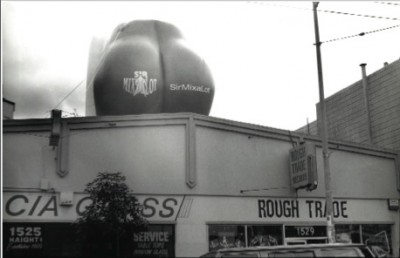
Come have a laugh at my expense tonight: I’ll be telling my personal stories from the “Baby Got Back” era tonight at The Soundtrack Series (alongside luminaries like Maura Johnston and Sasha Frere-Jones) at New York City’s Le Poisson Rouge (The Red Fish, for you Freedom Fries folks), 158 Bleecker Street in money makin’ Manhattan.
——————-
PICTURED: The “Butt Balloon” makes its street debut in San Francisco, February 1992; and it’s Hollywood debut in the movie “Falling Down” with Michael Douglas.
The new book that I co-authored with Bill Adler and Cey Adams — Def Jam: The First 25 Years Of The Last Great Record Label (Rizzoli) — is out this week. (Click HERE to buy the book.) So much more than a “coffee table” book, it’s a comprehensive oral history of the label. The book is being feted around New York in the coming week.
Tomorrow night, Paul Holdengraber will host a conversation at the New York Public Library with Rick Rubin and Russell Simmons (the first time, I believe that those two have ever appeared together in public for such a discussion). The event, as of now, is sold out.
Then, on Monday, Bill, Cey and I will have a considerably more low-key discussion at NYU — fitting in that Def Jam actually started there.
Sylvia Vanderpool Robinson — the woman who produced the first commercially successful hip-hop record and perhaps the first female record producer in history — died this morning of heart failure. She was 75. (I know that some accounts have her birthday in 1938, not 1936, but from family accounts I believe the earlier date is true).
I covered Sylvia’s life extensively in The Big Payback, and I will likely have some more thoguhts to share on this occasion shortly. But until then, here are some vital links:
Me upon hearing the news: “You guys have an issue about Jews? Nice!”
Many thanks to the good folks at Vibe for this inexplicable honor. One of those kinds of features that you read, but never imagine you’d be in.
Great to share a page with dream hampton for the first time since our days at The Source in the 1990s. And I look almost as tall as Derrick Rose. Weird to be in the same spread with luminaries like Kasim Reid, comedians like Kevin Hart, and true heroes like Wael Ghonim.
It was definitely reward enough to be able to tell the story I told in The Big Payback. This is a really sweet supplement.
Music criticism may be going the way of the CD in the Internet age, as critics no longer have much of a lead on fans in procuring new music, and fans have more platforms than ever to share their opinions directly with each other. We have, alas, become the squeezed-out middlemen.
But folks my age remember a time not so long ago when music critics were demigods, holy filters for the good, bad and the ugly.
So it still gives me a little chill when a guy like Robert Christgau — who’s been dubbed the “dean” of music criticism, with good reason — mentions my book.
Thanks to Michaelangelo Matos, the finest of a new generation carrying the critical torch, for hipping me to this one.
I told my wife last year that I wouldn’t feel truly fulfilled as a first-time author until I saw a random person on the train reading my book.
Last night, it happened.
Her name is Ephrat, she’s a dancer (and a b-girl at that), and she actually got the book from a friend of mine, MiRi Park. Read the rest of this entry »
I’ve had a number of peak experiences since the release of The Big Payback, some public (like being interviewed on radio and in print) and some more personal (the emails and Tweets and phone calls from friends, family, colleagues and strangers alike).
But there’s a special thrill for me in The Big Payback making New York magazine’s “Approval Matrix” this week:
Of course, my Mom and Dad like that the book cover gets to loiter right by the sign that says “Brilliant.”
But, for me, it’s the positioning of the book between “Highbrow” and “Lowbrow” that validates what I was trying to do as a writer, and in many ways reflects the ethos of hip-hop itself, and of the man who first captured its ultimate potential as recorded art, my former boss Rick Rubin.
Bobby Robinson, the founder of one of the first rap labels, Enjoy Records, and the first record man to sign a bonafide hip-hop act from the streets of the Bronx — Grandmaster Flash & the Furious Five — died Saturday at the age of 93.
I was lucky enough to be able to meet and interview the man during the course of researching my book, The Big Payback: The History of the Business of Hip-Hop. When I began my reporting in January of 2007, local papers were reporting that Robinson would soon be evicted from the record shop he had run in Harlem since World War II. And Robinson was getting up there in age, too, so I felt a bit of urgency to get his story.
Getting it wasn’t easy. Robinson — like many others — was tired of giving his jewels away for free, and had the idea that he was going to write a book about his life. So I decided to just hang around for a while instead.